One Platform for the Agentic AI Era
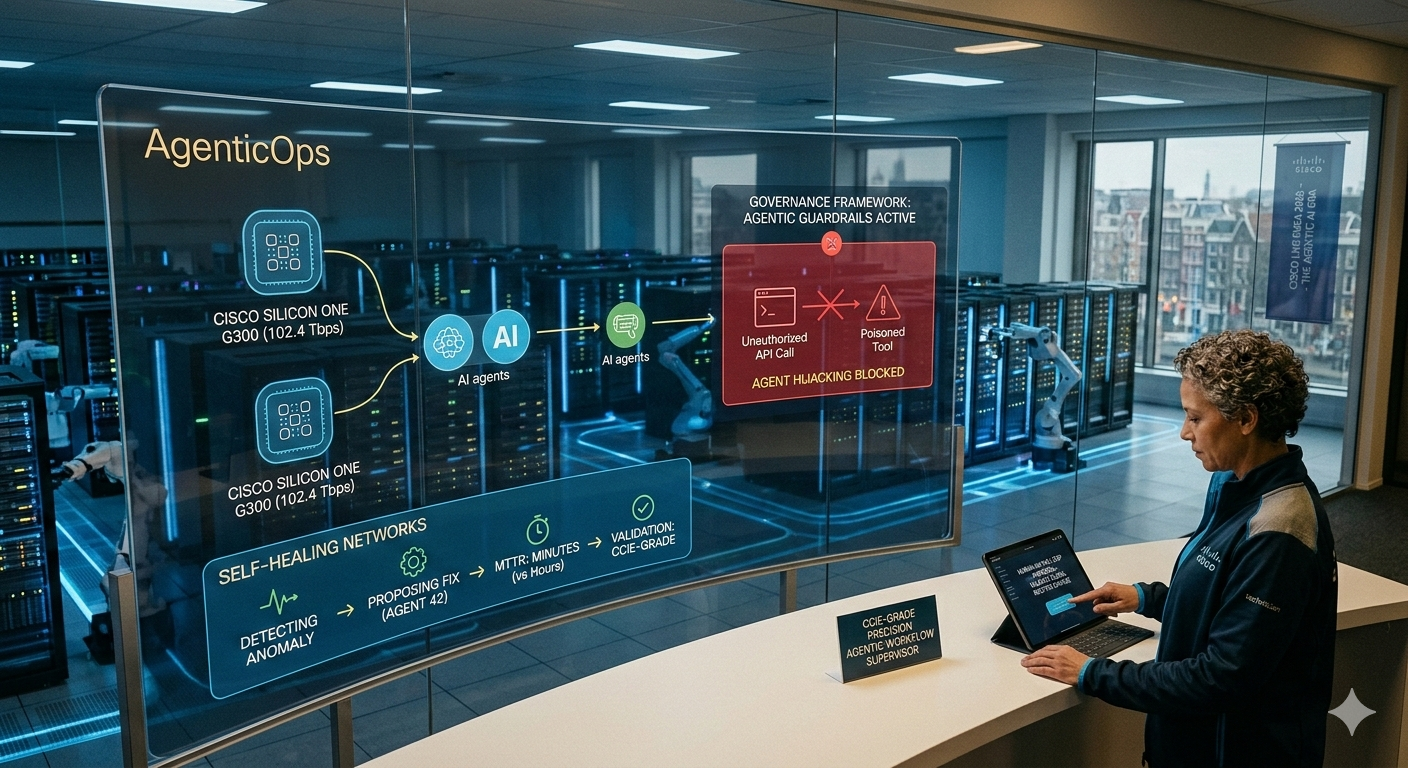
In the fast-paced world of technology, 2026 has already marked a significant turning point: the transition from "Generative AI" (which talks) to "Agentic AI" (which acts). On February 10, 2026, Cisco unveiled a comprehensive strategy titled "One Platform for the Agentic AI Era" at Cisco Live EMEA in Amsterdam. This move signals a shift from fragmented AI tools toward a unified, autonomous infrastructure capable of self-healing and proactive security.
The move to the "Agentic Era" is anchored by the Silicon One G300, a 102.4 Tbps switching chip designed for gigawatt-scale AI clusters (Cisco Newsroom, 2026b). This hardware powers AgenticOps, a new operating model that uses AI to autonomously troubleshoot and optimize networks. According to Cisco (2026a), this system can reduce Mean Time to Resolution (MTTR) from hours to minutes by validating hypotheses with "CCIE-grade precision." However, as enterprises move beyond pilots, they face significant hurdles.
Emerging Issues: Security and Governance
The primary challenge of Agentic AI is that it introduces agency-specific risks. Unlike traditional software, agents interact with third-party tools and APIs that can be compromised. One notable issue is the "Poisoned Tool" problem. Cisco (2026c) warns of "agent hijacking," where an agent is manipulated via malicious prompts or compromised external tools to execute unauthorized actions, such as bypassing firewall policies. Another issue is the "Governance Crisis," with industry reports suggesting that 40% of agentic AI projects will fail by 2027 (Deloitte, 2025). One final issue we'll discuss is legacy friction. Many organizations lack the modern infrastructure, APIs, and real-time data pipelines required to support agents that must make split-second decisions based on live telemetry (World Economic Forum, 2025).
Strategic Recommendations for Implementation
To navigate these risks, organizations must adopt a "trust-first" framework that balances raw power with rigorous control. Organizations should utilize Cisco's updated AI Defense suite, which includes "Agentic Guardrails" to inspect the "why" and "how" of agent interactions in real-time (Cisco Newsroom 2026c, 2026). These enterprises should also establish an AI Bill of Materials (AI BOM). Centralized visibility is vital, so using an AI BOM enables teams to track the provenance of every model and third-party dependency, helping secure the AI supply chain against hidden vulnerabilities (Cisco Newsroom 2026b, 2026). In addition to these controls, AI agents should be implemented with narrow workflows and Human-in-the-Loop (HITL) checkpoints. This allows AI agents to be supervised, and high-risk actions—such as global routing changes—should require a "one-click" human validation before execution (Ema, 2025). Lastly, organizations should treat every agent as a non-human identity. Implementing ephemeral credentials and applying the principle of least privilege will help to ensure that if an AI agent is compromised, the "blast radius" is contained (Deloitte, 2025).
Conclusion
Cisco's vision of a unified platform addresses the infrastructure bottleneck, but the ultimate success of agentic AI depends on governance. Organizations and their tools are only as strong as the controls implemented to govern them. By combining high-performance hardware such as the Silicon One G300 with robust AgenticOps and security guardrails, enterprises can transition from reactive assistance, such as generative chatbots, to an autonomous digital workforce.